You do not need to understand neural networks to understand this. You only need to understand a chef – and what happens when you change the brief.
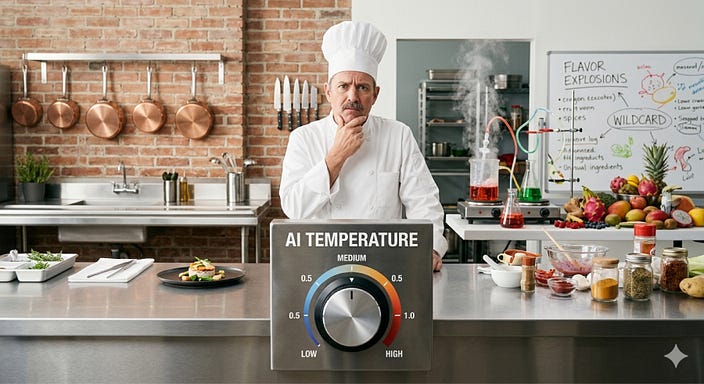
Here is something that surprises most people the first time they notice it. You can ask an AI the exact same question on two different days and receive two meaningfully different answers – not because something broke, and not because the AI is being inconsistent in the way a moody colleague might be. It is because there is a dial, and someone left it in the middle.
That dial is called temperature. It is a setting baked into every AI system you have ever used. And once you understand what it does, a whole range of behaviour that used to feel random becomes entirely predictable – and, more importantly, useful.
The same chef, two very different kitchens
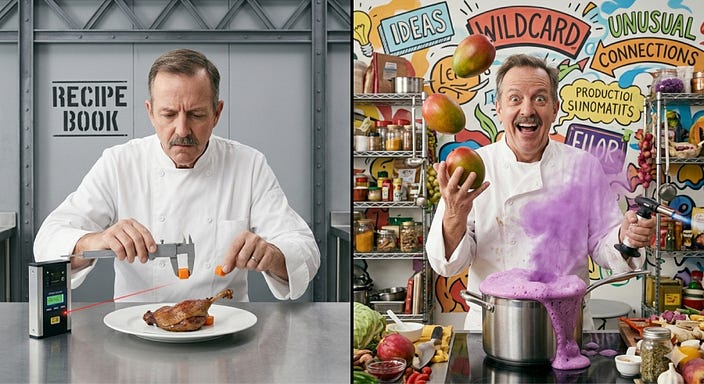
Imagine a chef of extraordinary talent. In the first kitchen, they work in a fine dining restaurant with a strict recipe book. Every plate must be identical. The chef follows instructions faithfully, precisely, without improvisation. You order the duck and you receive the duck, exactly as the menu describes it, every single time.
In the second kitchen, the same chef works in a creative test kitchen with no fixed menu. They have been told only to cook something wonderful. They roam the pantry freely, combine things unexpectedly, and produce something you never would have thought to order. Sometimes it is extraordinary. Occasionally it is strange. It is always surprising.
The chef has not changed. The kitchen has. And that is all temperature is – the difference between a recipe-bound kitchen and a free-roaming one.
A low-temperature AI stays close to the recipe. It gives you accurate, predictable, tightly-reasoned answers. A high-temperature AI roams the pantry. It makes unexpected connections, tries unusual combinations, and produces output that can range from inspired to incoherent – often in the same session.
Why the same question gets different answers
Most AI tools – the ones you use through a browser or an app – do not expose the temperature dial directly. There is no slider you can drag. But the dial exists, and it is set somewhere by default. Usually around the middle. And the middle means the AI is doing both things at once: it is trying to be accurate and it is allowing itself to wander a little.
That wandering is why you will sometimes ask the same question twice and notice the answer phrased differently, the structure changed, a detail emphasised that was not emphasised before. The AI is not choosing to be inconsistent. It is sampling from a range of plausible answers, and at medium temperature, that range is wide enough to produce variation.
Both answers are correct responses to the same prompt. One is the fine-dining duck. One is the test kitchen surprise. Which you want depends entirely on what you are actually trying to accomplish.
The practical translation
You cannot always move the dial directly – but you can move it with your words. The phrasing of your prompt is the most powerful temperature control available to a non-engineer.
When you want the low-temperature kitchen – reliable, precise, repeatable – use language that signals constraint. “Give me exactly three options, no more.” “Use only the information I have provided.” “Format this as a table.” These instructions push the AI toward the recipe book. They narrow the pantry.
When you want the high-temperature kitchen – generative, surprising, exploratory – use language that signals freedom. “Surprise me.” “What’s an unexpected angle on this?” “Ignore the obvious approach.” These instructions open the pantry doors. They tell the chef to roam.
Where most people go wrong

The most common mistake is using a high-temperature mindset for a low-temperature task. You need the AI to extract the key dates from a contract. You need it to summarise a meeting transcript accurately. You need it to check whether two figures are consistent. These are precise tasks. They do not benefit from pantry-roaming. They need the recipe book.
When you ask for precision but frame the request loosely – “tell me what’s interesting in this document” – the AI brings creativity to a job that required accuracy. It will find things that are interesting. They may or may not be the things that matter. The output will look helpful. It may not be.
The inverse is also true. You need fresh ideas for a campaign. You need an unusual name for a new initiative. You need something that does not sound like every other company’s announcement. These are generative tasks. If you frame them with too many constraints, you squeeze the creative range and get exactly what you were trying to avoid: the same answer everyone else would have gotten.
The move that costs nothing
Before you send any substantive prompt, take three seconds to ask yourself which kitchen you actually want. Precision or imagination? Reliability or surprise? Extraction or generation?
Then phrase your request accordingly. Use constraint language for precision. Use permission language for creativity. You do not need to know the word “temperature.” You do not need access to any settings panel. The words you choose are already the dial.
The AI is not moody. It is not inconsistent. It is a chef waiting to be briefed. Tell it which kitchen it is in – and it will cook accordingly.
There is a lot of mysticism around AI right now. People either treat it as an oracle that should be trusted completely, or a black box that cannot be reasoned with. The truth is quieter and more useful than either. These systems have knobs. The knobs respond to plain language. And the people who get the most out of them are not the ones who understand the engineering – they are the ones who have learned to brief the chef.